Research Areas
Biodiversity
Restoration Ecology
Ecological Engineering
Bioacoustics
Network Ecology
Human–Nature Interactions
Monitoring & Field Methods
Quantitative Ecology
Modeling & Simulation
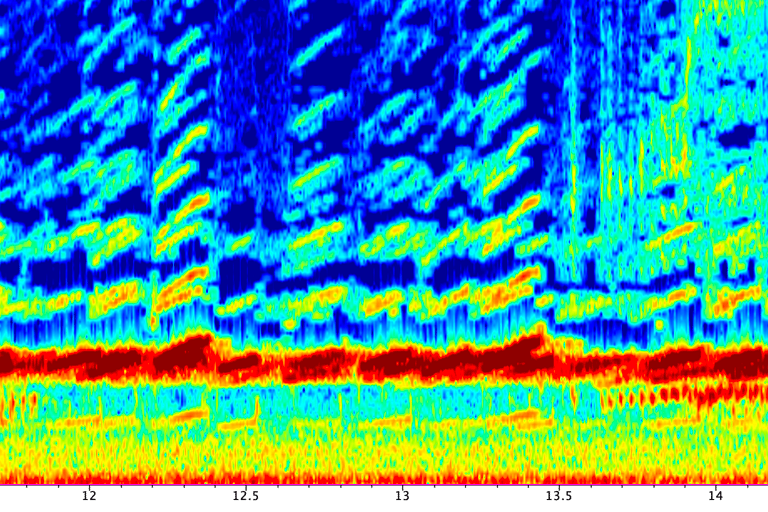
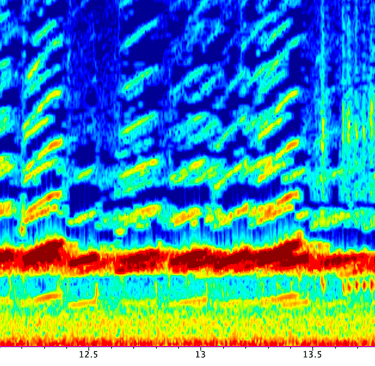
Spectrogram of Spring Peeper (Pseudacris crucifer) Chorus, Van Cortlandt Park 2022
Current Projects
Urban Rivers are Home to Unique Insects That are Negativly Effected by Winter Road Salt
Linking Water Chemistry to Benthic Macroinvertebrates in Tibbetts Brook
This project examines how variation in water chemistry influences benthic macroinvertebrate (BMI) community composition in an urban stream system. By pairing high-resolution physicochemical measurements (e.g., conductivity, nutrients, dissolved oxygen, and contaminants) with detailed BMI surveys, we aim to identify the key environmental drivers shaping aquatic biodiversity in heavily urbanized watersheds. Results will provide insight into how urban stressors alter stream food webs and biological integrity, informing both ecological theory and applied water-quality management.
Fungi and Plants are Engaged in a Romance That Help Forests Store Carbon
Mycorrhizal Guild Effects on Belowground Carbon Allocation in Urban Forests
This project examines how mycorrhizal guild composition alters belowground carbon allocation and storage in urban forests, challenging the guild-neutral assumptions used in standard carbon accounting. Using forest inventory data from New York City, we re-estimate belowground carbon stocks by integrating guild-specific allocation ratios for arbuscular and ectomycorrhizal trees and compare these estimates to conventional Jenkins-based methods. We then apply a dynamical carbon allocation model to test how differences in mycorrhizal strategies interact with urban stress, represented as increased root turnover, to shape equilibrium carbon pools. By linking symbiotic guild traits to mechanistic allocation dynamics, this work reveals systematic biases in current urban forest carbon estimates and provides a framework for incorporating mycorrhizae into urban ecosystem carbon models.
Sound Monitoring Represents an Underutlized Tool to Document the Biodiversity of Cities
Bioacoustics of New York City Parks
This project uses passive acoustic monitoring to characterize soundscapes and animal communication across parks throughout New York City. By analyzing bioacoustic data from birds, amphibians, and insects alongside measures of urban noise and habitat structure, we assess how anthropogenic sound and landscape context shape signaling behavior, activity patterns, and species presence. The project contributes to a growing understanding of acoustic ecology in cities and explores how soundscape monitoring can be used as a non-invasive tool for urban biodiversity assessment and conservation planning.
Urban Biodiversity Under the Microscope: From Inventories to Networks
Natural Resource Inventories, Scale-Dependent Biodiversity Patterns, and Species–Habitat Networks in New York City Parks
A central focus is how biodiversity patterns vary with spatial grain and extent in urban forests, with particular attention to edge effects. The project tests how edge influence interacts with spatial scale to shape species richness and composition, predicting greater representation of disturbance-tolerant and invasive species at edges and increased dominance of shade-tolerant native taxa in forest interiors. Complementary analyses examine plant species-area relationships across nested spatial extents to evaluate how classical scaling laws perform in heterogeneous urban landscapes and when deviations occur. Building on prior work in Van Cortlandt Park, the project extends a grain × extent framework from understory plants to terrestrial insects, enabling cross-trophic comparisons. Finally, a species-habitat network approach is applied to terrestrial insects to assess how habitat diversity and configuration structure insect communities in urban ecosystems.
Ecological Theory as a Blueprint for Restoring Biodiversity and Ecosystem Function
Applying Community Assembly and Trait-Based Theory to Improve Ecological Restoration Outcomes
This project examines how explicit application of community ecology theory can improve the predictability and effectiveness of ecological restoration. Using replicated restoration experiments across degraded sites, we will compare conventional restoration approaches with theory-informed treatments that manipulate ecological filters, priority effects, and functional trait composition. We then quantify how these mechanisms influence community reassembly, species coexistence, and ecosystem processes over time. By linking foundational ecological theory to measurable restoration outcomes, this work identifies when and how theory-guided interventions outperform traditional practices and provides a mechanistic framework for integrating community ecology into restoration planning and evaluation.
Past Projects